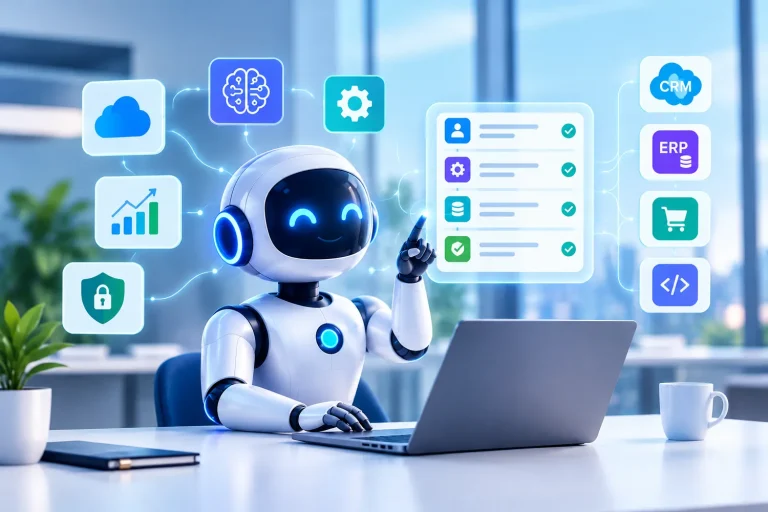
Artificial Intelligence is becoming an important part of modern business software. From customer support and workflow automation to data analysis and software development, AI-powered applications are helping businesses work more efficiently.
However, AI applications often need access to external tools, databases, APIs, and business systems to perform useful tasks.
This is where Model Context Protocol (MCP) comes in.
MCP is an open protocol that provides a standardized way for AI applications to communicate with external tools and data sources. Instead of building separate integrations for every AI application, developers can use MCP to create more reusable connections.
As AI-powered software continues to evolve, MCP is becoming an important technology for building connected and intelligent business applications.
What Is Model Context Protocol (MCP)?
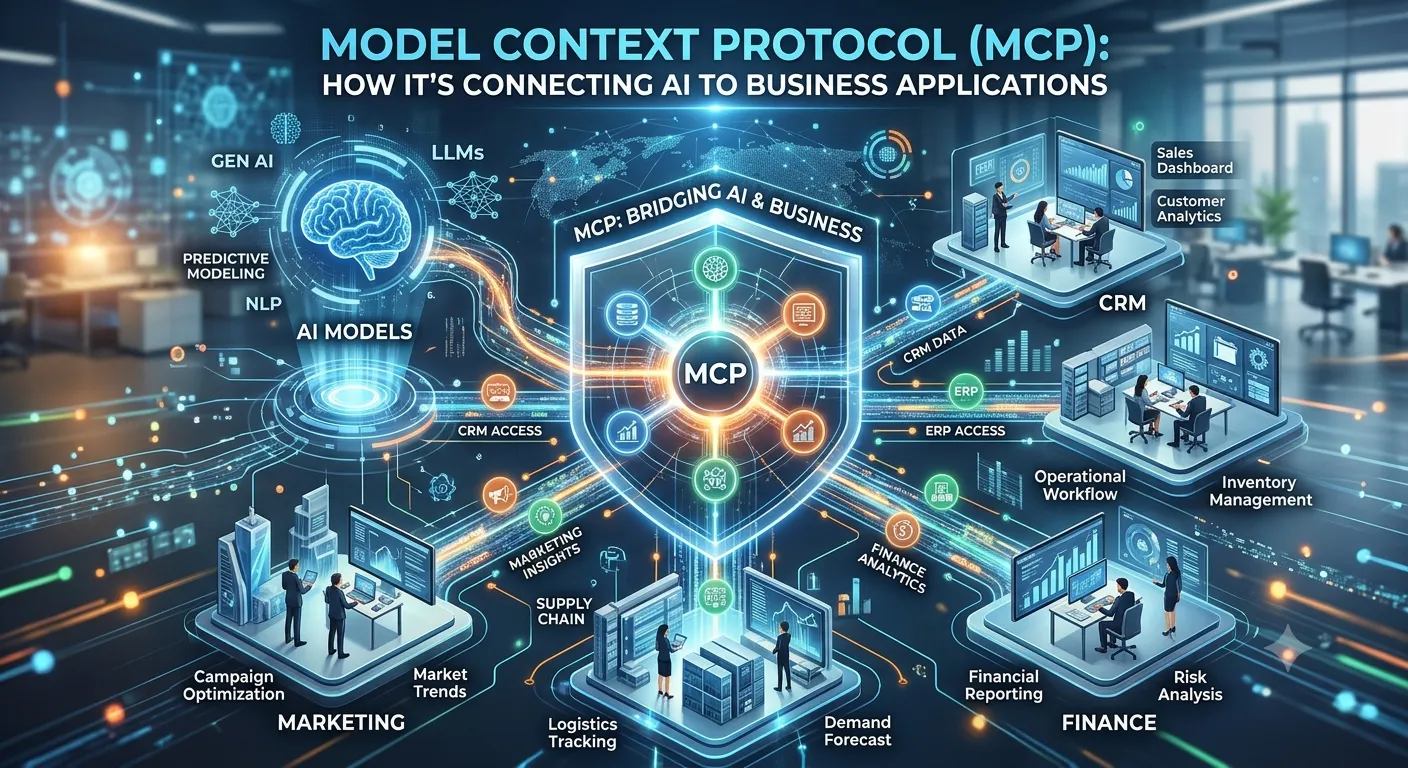
Model Context Protocol (MCP) is an open standard that allows AI applications to connect with external systems through a consistent communication interface.
Think of MCP as a bridge between an AI assistant and the tools it needs to complete a task.
For example, imagine a business uses an AI assistant to manage daily operations. The assistant may need to:
- Retrieve customer information from a database.
- Check project updates from a project management tool.
- Read documents from a company knowledge base.
- Access information through an external API.
- Perform approved actions in connected business applications.
MCP provides a standardized way to expose these capabilities to AI applications.
This makes it easier for developers to connect AI systems with different services without creating every integration from scratch.
How Does MCP Work?
MCP follows a client-server architecture that allows AI applications to communicate with external tools and resources.
Its main components include:
1. MCP Host
The host is the AI application that the user interacts with.
For example, it could be an AI assistant, desktop application, or development environment.
2. MCP Client
The client manages communication between the AI host and an MCP server.
It handles requests and responses using the MCP protocol.
3. MCP Server
The server exposes specific capabilities to the AI application.
These capabilities can include tools, resources, and reusable prompts.
4. External Systems
These are the services and data sources that the MCP server connects to, such as databases, APIs, file systems, and business applications.
A Simple Example
Imagine a company wants an AI assistant to retrieve customer order information.
- The user asks the AI assistant to check an order.
- The AI application identifies the relevant capability.
- The MCP client communicates with the appropriate MCP server.
- The server accesses the connected order management system.
- The requested information is returned to the AI application.
- The assistant presents the result to the user.
The exact workflow depends on the application’s design, available tools, and permissions.
Why Is MCP Important for AI Development?
Before standardized integration protocols, developers often had to build custom connections between individual AI applications and external services.
MCP helps simplify this process by providing a common interface.
Here are some important advantages.
1. Standardized Integrations
Developers can create MCP servers that expose capabilities in a consistent format, making integrations easier to reuse across compatible AI clients.
2. Better Connectivity
AI applications can connect with multiple external systems, including databases, APIs, and business tools.
3. Reduced Integration Complexity
A standardized protocol can reduce the need to develop completely separate integration logic for every supported AI application.
4. Flexible Architecture
Businesses can build modular systems where AI applications and external services can evolve independently, provided they maintain compatible interfaces.
5. More Capable AI Applications
With suitable tools and permissions, AI applications can retrieve information and perform approved operations instead of relying only on their built-in knowledge.
Real-World Business Use Cases of MCP
MCP can support a wide range of business applications.
1. AI-Powered Customer Support
An AI assistant can connect with customer management systems to retrieve order details, check support tickets, and provide relevant responses.
Sensitive actions should require suitable permissions and verification.
2. Business Process Automation
MCP can help AI applications interact with approved business tools to support repetitive workflows.
For example, an assistant could retrieve project information, prepare a report, and request approval before updating a business record.
3. Data Analysis and Reporting
Businesses can connect AI applications with databases and reporting systems to retrieve information and generate useful summaries.
4. Software Development
Development assistants can connect with code repositories, documentation, issue trackers, and development tools to help developers understand projects and manage tasks.
5. E-Commerce Management
An AI application can connect with product catalogs, order management systems, and inventory services to retrieve relevant information.
6. Internal Knowledge Management
Companies can connect AI assistants with approved internal documents and knowledge bases to help employees find relevant information faster.
MCP vs Traditional API Integration
MCP and traditional APIs are not direct replacements for one another. They serve different but complementary purposes.
Traditional API Integration
- Developers connect applications using specific API endpoints.
- Each service may require its own integration logic.
- Authentication and data handling depend on the API.
- Integrations are often designed around particular application requirements.
MCP Integration
- Provides a standardized protocol for AI applications to communicate with connected services.
- Exposes capabilities through a consistent interface.
- Helps compatible AI clients discover and use available tools.
- Can make integrations reusable across supported AI applications.
Important: MCP commonly works with existing APIs behind the scenes. It provides an AI-friendly integration layer rather than eliminating the need for APIs.
7 Important Steps to Build an MCP Integration
Businesses planning to adopt MCP should follow a structured development approach.
1. Identify Business Requirements
Determine which business systems the AI application needs to access and what problems the integration should solve.
2. Choose the Right Architecture
Decide whether you need a local or remote MCP server and identify the systems that will provide the required capabilities.
3. Define Tools and Resources
Expose only the tools and resources required by the application.
Keep capabilities focused and clearly documented.
4. Configure Authentication
Use appropriate authentication and authorization mechanisms to ensure that users and AI applications can access only permitted resources.
5. Implement Security Controls
Validate inputs, restrict access, protect sensitive information, and apply appropriate permission checks.
6. Test the Integration
Test tool discovery, requests, responses, error handling, authentication, and performance.
7. Monitor and Maintain
Monitor server activity, review access permissions, update dependencies, and maintain compatibility with supported protocol versions.
Security Challenges Businesses Should Understand
MCP makes integrations easier, but it does not automatically make connected systems secure.
Businesses should carefully consider the following risks.
Unauthorized Access
An incorrectly configured server may expose sensitive data or allow unauthorized operations.
Excessive Permissions
Giving an AI application more access than it needs can increase the potential impact of security incidents.
Prompt Injection
Malicious instructions in external content may attempt to influence an AI application’s behavior.
Data Privacy
Sensitive business information should be protected when it moves between AI applications and external services.
Unsafe Tool Execution
Tools that modify records, send messages, or perform other important actions should have appropriate authorization and approval controls.
A secure MCP implementation should follow least-privilege access, input validation, clear authorization policies, logging, and human approval for sensitive operations.
The NSA has also published security design considerations for AI-driven automation using MCP, highlighting the importance of secure implementation.
MCP and the Future of Business Software
The future of business applications is moving toward more connected and intelligent systems.
Instead of operating independently, software platforms can increasingly work together through standardized integration approaches.
MCP can help developers build applications where AI systems interact with business data and approved tools through a consistent protocol.
The Model Context Protocol project has continued to evolve its specification, with improvements focused on scalability, authorization, and enterprise readiness.
Google Cloud has also introduced managed MCP servers for connecting AI applications with Google Cloud services.
These developments show that MCP is becoming an important part of the evolving AI integration ecosystem.
However, successful adoption will depend on security, compatibility, governance, and practical business value.
How Saini Tech Labs Can Help Your Business
At Saini Tech Labs, we develop modern technology solutions that help businesses improve efficiency and build smarter digital experiences.
Our services include:
- Software Development: Build custom applications and integrate business systems.
- Web Development: Create modern websites with powerful functionality and API integrations.
- Mobile App Development: Develop connected mobile applications for Android and iOS.
- E-Commerce Development: Build scalable online stores with integrated business functionality.
- AI & Automation: Explore intelligent automation and AI-powered business workflows.
We focus on developing secure, scalable, and practical solutions that support your business goals.
Conclusion
Model Context Protocol is helping simplify how AI applications communicate with external tools, databases, and business systems.
By providing a standardized integration approach, MCP gives developers new opportunities to build connected AI-powered applications.
For businesses planning their next digital transformation project, understanding MCP can help identify opportunities for smarter automation, better system connectivity, and more capable software.
The next generation of business software will not just store information. It will help users interact with connected systems in more intelligent ways.
Ready to build smarter business applications? Let’s discuss your project with Saini Tech Labs.